

 Français (France)
  Nederlands (nl-NL)
 The Shore Temple of Mahabalipuram is one of the best-known monuments on the coast of Tamil Nadu. Built facing the Bay of Bengal, it forms part of the monumental ensemble developed under the Pallava dynasty and represents an important stage in the evolution of South Indian stone temples. The site combines shrines, enclosure walls and sculptural elements within an environment directly exposed to maritime conditions. The monument reflects the historical role of Mahabalipuram as both a religious centre and a port settlement during the first millennium. The Shore Temple is now included in the Group of Monuments at Mahabalipuram, inscribed on the UNESCO World Heritage List in 1984.
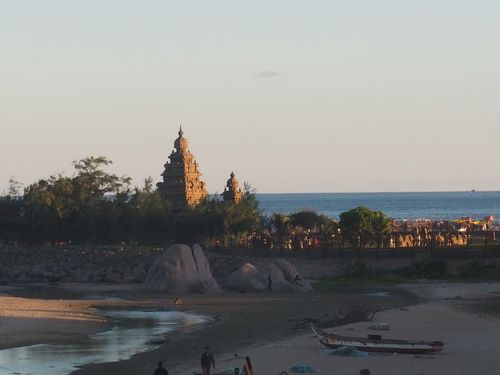
Mahabalipuram • Shore Temple: Shore temple seen from the beach
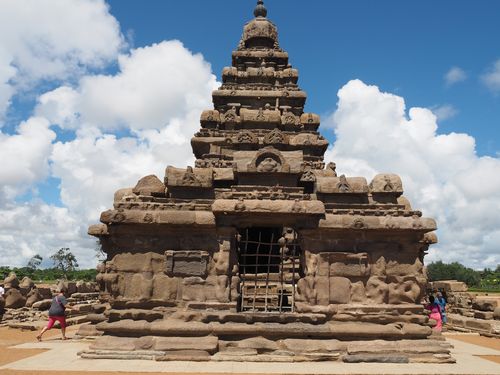
Mahabalipuram • Shore Temple: The Shore temple
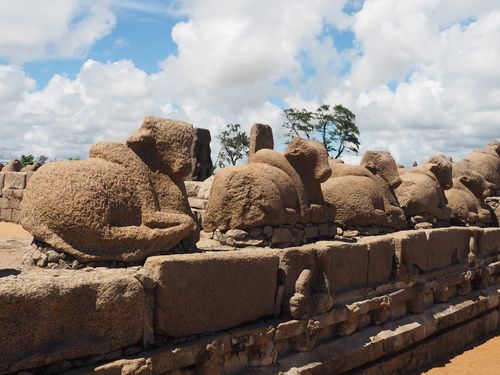
Mahabalipuram • Shore Temple: Nandi's alignment
Monument profile
Shore Temple
Monument categories: Hindu Temple, Dravidian temple
Monument family: Temple
Monument genre: Religious
Cultural heritage: Hindu
Geographic location: Mahabalipuram • Tamil Nadu • India
Construction period: 7th century AD
This monument in Mahabalipuram is inscribed on the UNESCO World Heritage List since 1984 and is part of the serial property "Group of Monuments at Mahabalipuram".See the UNESCO monuments featured on this site
• Links to •
• Dynasties that contributed to the construction of the monument •

• List of videos about Mahabalipuram on this site •
Mahabalipuram, excavated temples • Tamil Nadu, India
• References •
UNESCO: Group of Monuments at Mahabalipuram
Historical Development of the Shore Temple at Mahabalipuram
Pallava Foundation and Religious Context
The Shore Temple was constructed during the reign of the Pallava king Narasimhavarman II Rajasimha in the early 8th century CE, at a time when Mahabalipuram functioned as an important royal and maritime centre on the Coromandel Coast. Unlike many earlier monuments at the site carved directly into granite outcrops, the Shore Temple belongs to the later phase of Pallava architecture characterised by structural stone construction. Its erection reflects a significant transformation in royal architectural patronage and temple-building practices under the Pallava dynasty.
The complex was conceived primarily as a Shaivite monument, although it also incorporates Vaishnavite elements through the presence of a reclining Vishnu shrine positioned between the two principal Shiva sanctuaries. This combination illustrates the coexistence of multiple Hindu devotional traditions within Pallava royal ideology. The monument’s location directly facing the sea also reinforced its symbolic and political visibility for maritime traffic approaching the coast.
The temple likely formed part of a larger sacred and ceremonial landscape associated with the port activities of Mahabalipuram. Literary traditions and later accounts referring to “Seven Pagodas” suggest that additional coastal structures may once have existed in the surrounding area, although archaeological evidence remains limited.
Political Role and Monumental Significance
The construction of the Shore Temple coincided with a period of Pallava political consolidation and artistic expansion. By commissioning a large structural temple on the coastline, the Pallava rulers demonstrated both technological capability and royal authority. The monument represented a visible statement of dynastic legitimacy linked to religion, trade and maritime power.
Its architectural form differs from the earlier monolithic rathas and cave sanctuaries of Mahabalipuram. The use of assembled granite blocks reflects increasing experimentation with permanent temple forms that later became central to Dravidian architecture in South India. The Shore Temple therefore occupies an important transitional position in the historical development of South Indian temple construction.
The monument also appears to have maintained ritual significance beyond the Pallava period. Successive regional powers continued to recognise Mahabalipuram as a sacred coastal centre, even as political authority shifted between different dynasties in southern India.
Exposure to the Maritime Environment and Historical Transformations
The temple’s direct exposure to the Bay of Bengal profoundly influenced its historical evolution. Salt-laden winds, humidity and coastal storms gradually eroded sculptural surfaces and architectural details over centuries. Unlike inland temples protected from maritime conditions, the Shore Temple remained continuously vulnerable to environmental deterioration.
European travellers and colonial observers described the monument from the seventeenth century onward, often emphasising its dramatic coastal position. During the colonial period, archaeological interest in Mahabalipuram increased significantly, leading to documentation campaigns and early conservation measures under British administration.
Excavations and surveys conducted during the twentieth century improved understanding of the surrounding archaeological landscape. Some investigations revealed buried structural remains and enclosure features partially concealed by sand deposits accumulated over long periods of coastal activity.
Modern conservation efforts have concentrated on stabilising the granite structures and limiting further erosion. Protective barriers, drainage systems and controlled visitor management were progressively introduced to reduce environmental and human impact on the monument.
UNESCO Recognition and Contemporary Importance
The Shore Temple forms part of the UNESCO World Heritage property “Group of Monuments at Mahabalipuram,” inscribed in 1984. Within this ensemble, the monument occupies a particularly important position because it represents one of the earliest surviving structural temples of South India built directly on the coastline.
Today the temple functions simultaneously as an archaeological monument, a symbol of Pallava artistic achievement and an active cultural landmark associated with the historical identity of Tamil Nadu. Although regular ritual activity is more limited than in major functioning temple complexes, the site retains religious significance for many visitors and pilgrims.
Its silhouette facing the Bay of Bengal has become one of the most recognisable visual representations of Mahabalipuram. The monument also continues to play an important role in heritage tourism, academic research and conservation programmes focused on coastal archaeological preservation.
Historical Context During the Temple’s Construction
The Shore Temple was constructed during the early 8th century, when the Tang dynasty governed China and the Umayyad Caliphate expanded across parts of Asia, North Africa and Europe. In Southeast Asia, maritime trade networks connected the Indian Ocean with regional kingdoms such as Srivijaya. In Europe, the early medieval period was marked by the consolidation of post-Roman kingdoms, while the Byzantine Empire remained active in eastern Mediterranean politics.
Structural Composition and Coastal Architecture of the Shore Temple at Mahabalipuram
Coastal Setting and General Layout
The Shore Temple occupies an exposed position directly along the Bay of Bengal on the eastern edge of Mahabalipuram. Its implantation differs significantly from earlier Pallava monuments carved into inland granite outcrops. The complex was deliberately positioned in open coastal terrain where its silhouette remained visible from both the shoreline and maritime approaches. This setting strongly influenced the monument’s architectural organisation, structural stability and preservation conditions.
The temple stands on a slightly elevated stone platform intended to reduce exposure to shifting sand, water infiltration and periodic coastal flooding. Although relatively compact, the complex incorporates several distinct sanctuaries arranged within a rectangular enclosure. The plan follows a longitudinal organisation that creates a clear axial progression through the site.
Two principal Shiva shrines dominate the composition. Between them lies a smaller sanctuary associated with a reclining Vishnu representation. This arrangement creates an unusual spatial hierarchy in which vertical temple towers frame a lower horizontal sacred volume. Enclosure walls and sculptural alignments reinforce the sacred perimeter while guiding circulation around the principal structures.
The monument’s visual effect depends heavily on the contrast between vertical superstructures and the openness of the surrounding coastal landscape. Because the terrain remains largely unobstructed, the pyramidal towers dominate the site visually.
Structural Construction and Granite Techniques
The Shore Temple belongs to the structural phase of Pallava architecture rather than the earlier monolithic tradition visible elsewhere in Mahabalipuram. Instead of excavating living rock, Pallava craftsmen assembled the monument from carefully cut granite blocks. This transition marks an important stage in the development of South Indian stone temple construction during the early eighth century.
The granite was probably extracted from nearby local formations. Its hardness imposed limitations on highly delicate carving but provided exceptional durability. The monument therefore emphasises stable geometric masses and clearly defined structural volumes rather than extremely elaborate ornamental detail.
The masonry demonstrates careful weight distribution. Granite blocks were assembled in horizontal courses that stabilised the towers while resisting coastal climatic conditions. Structural cohesion depends largely on the mass and compression of the stone elements rather than extensive mortar use.
Surface treatment varies across the complex. Some planes were carefully smoothed to reinforce geometric clarity, while others preserve traces of carving marks and slight irregularities associated with manual stoneworking. These variations contribute to the monument’s visual texture and reveal aspects of the construction process.
The coastal environment influenced the engineering logic of the temple. Granite elements were assembled with compact proportions and thick supporting walls capable of resisting humidity, salt-laden winds and seasonal storms from the Bay of Bengal.
Sanctuaries and Spatial Organisation
The eastern Shiva shrine forms the tallest structure within the complex. Its pyramidal superstructure rises through progressively diminishing levels typical of early Dravidian temple architecture. The vertical rhythm of the tower contrasts sharply with the low horizontal profile of the surrounding coast.
Behind the principal shrine stands a second Shiva sanctuary facing the opposite direction. This dual orientation creates a spatial arrangement rarely encountered in later South Indian temple layouts. Between the two Shiva shrines lies the Vishnu sanctuary containing the reclining deity. Because of its horizontal iconography, this intermediate shrine preserves lower proportions and a more elongated internal configuration.
Interior spaces remain narrow and enclosed. The sanctum chambers were intended for concentrated ritual activity rather than large gatherings. Their limited dimensions increase the visual prominence of sculptural and symbolic elements within the confined architectural volumes.
Passages linking the shrines maintain continuity between interior and exterior space. Openings are integrated directly into thick granite walls without strongly projecting frames, reinforcing the compact coherence of the monument.
The enclosure surrounding the sanctuaries contributes significantly to the spatial experience of the site. Sculpted alignments, subsidiary structures and perimeter walls establish a controlled transition between sacred space and the surrounding coastal environment.
Exterior Articulation and Sculptural Integration
External walls are articulated through projections, niches, pilasters and recessed surfaces that interrupt the visual uniformity of the granite masses. These elements create alternating bands of light and shadow that become particularly visible under strong coastal sunlight.
The pyramidal towers preserve characteristic Dravidian forms with superimposed levels gradually narrowing toward the summit. Although erosion has softened many details, the geometric organisation of the superstructures remains clearly legible. Upper sections once contained sharper sculptural ornamentation, much of which has been worn down through prolonged marine exposure.
Decorative density remains carefully controlled throughout the complex. Instead of covering every surface with carving, Pallava craftsmen concentrated sculptural treatment around major iconographic and structural zones. This selective approach preserves the readability of the monument’s principal masses and architectural rhythm.
One of the most recognisable decorative features is the repetitive series of seated Nandi sculptures positioned along sections of the enclosure. These figures establish a strong horizontal rhythm around the sacred perimeter while reinforcing the Shaivite identity of the complex.
Reliefs integrated into the walls remain structurally connected to the surrounding granite rather than appearing as detached additions. Architecture and iconography therefore function together as a unified compositional system.
Conservation and Architectural Preservation
The Shore Temple faces major preservation challenges because of its direct exposure to the marine environment. Humidity, salt crystallisation, monsoon rains and abrasive coastal winds have progressively eroded sculptural surfaces and softened carved details.
Exterior zones facing the sea display the greatest deterioration. Fine decorative elements and shallow reliefs have often become rounded through centuries of exposure to salt-laden air and moisture. Despite this erosion, the principal structural volumes remain stable because of the durability of the granite construction.
Modern conservation measures focus mainly on stabilising existing architectural elements and limiting environmental damage rather than reconstructing missing details. Protective embankments, drainage systems and controlled site management have been introduced to reduce water infiltration and coastal erosion.
Current preservation policies prioritise the retention of original material and the readability of the historical structure. The monument therefore continues to display both its Pallava architectural organisation and the visible effects of centuries of interaction with the coastal environment.