

 Français (France)
  Nederlands (nl-NL)
 The Enchey Monastery is a Buddhist religious institution located in Gangtok, within the Indian state of Sikkim. Affiliated with the Nyingma school of Tibetan Buddhism, it plays a recognized role in the region’s religious life. The monastery supports an active monastic community and hosts regular rituals, including important annual religious observances. It also functions as a center for spiritual practice and monastic instruction. Through its ongoing activities, Enchey Monastery contributes to the preservation and transmission of Buddhist traditions within the contemporary cultural framework of Sikkim.
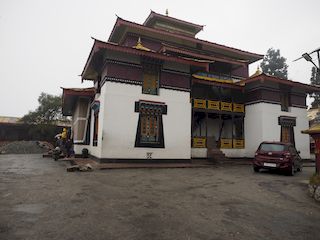
Gangtok • Enchey monastery

Gangtok • Enchey monastery

Gangtok • Enchey monastery
Monument profile
Enchey monastery
Monument category: Monastery
Monument family: Monastery
Monument genre: Religious
Cultural heritage: Buddhist
Geographic location: Gangtok • Sikkim • India
Construction period: 20th century AD
• Links to •
• List of videos about Gangtok on this site •
Gangtok, the capital • Sikkim, India
Historical Development of Enchey Monastery
Enchey Monastery occupies a significant position in the religious and political history of Gangtok, the present capital of Sikkim. Although its present form dates from the early twentieth century, the site is rooted in earlier layers of ritual and monastic activity connected to the Nyingma tradition of Tibetan Buddhism. The monastery’s foundation, evolution, and continued relevance reflect the interaction between spiritual authority and secular power in a Himalayan polity navigating profound regional and global transformations.
Political and Social Context of the Foundation
The establishment of Enchey Monastery must be understood within the framework of the Chogyal monarchy of Sikkim, which ruled the region from the seventeenth century until the mid-twentieth century. By the late nineteenth and early twentieth centuries, the Sikkimese state faced growing external pressures, particularly from British colonial authorities operating in the eastern Himalayas. At the same time, internal consolidation of authority remained a priority for the monarchy.
The monastery was constructed with the support of the ruling elite as part of a broader strategy to reinforce the symbolic and institutional foundations of the Buddhist state. Monastic institutions served not only as centers of religious practice but also as instruments of political legitimacy, anchoring royal authority in a shared spiritual framework. Enchey’s location near Gangtok, which was emerging as an administrative center, reflects a deliberate choice to align religious presence with political power.
Socially, the monastery responded to the needs of a Buddhist population for structured religious education, ritual continuity, and communal cohesion. Its affiliation with the Nyingma school, associated with early Tibetan Buddhist transmissions, reinforced the perception of doctrinal continuity and authenticity at a time when political modernity threatened traditional forms of authority.
Rivalries, Alliances, and Regional Dynamics
The construction of Enchey occurred in a region characterized by complex geopolitical relationships. Sikkim’s position between Tibet, Bhutan, Nepal, and British India made it a strategic buffer state. Religious institutions played a subtle but important role in maintaining alliances, particularly with Tibetan religious networks, while also signaling cultural autonomy to colonial powers.
Although Enchey was not built in response to direct military conflict, it was influenced by long-standing rivalries and diplomatic considerations. Supporting monastic establishments helped the Sikkimese monarchy assert cultural sovereignty and reinforce ties with Tibetan Buddhist lineages at a time when the region’s political future was increasingly uncertain.
Major Historical Events Affecting the Monastery
Throughout its history, Enchey Monastery has been shaped more by political transition and administrative change than by warfare or physical destruction. Unlike some Himalayan monastic sites, it was not subject to major sieges or pillaging. Its continuity owes much to its proximity to political authority and its integration into the institutional fabric of the state.
The most significant turning point came with the political transformation of Sikkim in the twentieth century. The gradual decline of the Chogyal monarchy and the eventual incorporation of Sikkim into the Republic of India in 1975 altered the relationship between religious institutions and the state. Enchey adapted to new administrative structures, transitioning from royal patronage to state-regulated cultural and religious frameworks.
Restoration campaigns during this period focused on maintaining ritual continuity rather than monumental reconstruction. These interventions ensured the survival of the monastery as a living institution rather than a purely historical relic.
Global Context at the Time of Construction
The period during which Enchey Monastery was formalized coincided with a broader global moment of cultural assertion across Asia. In many regions under colonial influence, religious architecture became a means of reaffirming identity and continuity. Buddhist, Hindu, and Islamic institutions were rebuilt or newly established to signal resilience in the face of political and cultural change.
In the Himalayan context, monastic construction during this era can be seen as part of a wider response to the destabilization of traditional polities. Enchey fits within this pattern as a localized expression of a global phenomenon: the use of religious architecture to preserve continuity amid modernity and external domination.
Transformations Over Time
Over the decades, Enchey Monastery has undergone several functional and spatial adjustments. While its core religious role has remained stable, changes in the surrounding urban environment have reshaped its relationship to Gangtok. What was once a relatively secluded religious site has become integrated into an expanding urban landscape.
Architectural modifications have been modest and primarily focused on maintenance, safety, and accommodation of visitors. These changes reflect shifting patterns of use, including increased participation by lay visitors and pilgrims alongside the resident monastic community.
Periods of relative decline, particularly during times of political uncertainty, were followed by renewed attention as cultural heritage became an increasingly important concern for regional authorities.
Contemporary Role and Cultural Significance
Today, Enchey Monastery remains an active religious center within Sikkimese society. It hosts regular rituals and annual religious festivals that draw participation from monks, local residents, and visitors. These events reinforce its role as a focal point of communal identity and spiritual life.
Beyond its religious function, the monastery serves as a symbol of Sikkim’s historical continuity. It represents the enduring influence of Tibetan Buddhism in shaping regional identity, even as Sikkim functions fully within the Indian nation-state. Enchey thus occupies a dual position: a living monastic institution and a cultural landmark embodying historical memory.
Conservation Status and Modern Challenges
The current state of conservation of Enchey Monastery is generally stable, but it faces several challenges. Environmental factors such as heavy rainfall, humidity, and seismic activity pose ongoing risks to traditional structures. Urban expansion around Gangtok has increased pressure on the site, raising concerns about visual integrity, noise, and visitor management.
Tourism, while contributing to awareness and economic support, introduces additional stresses, including wear on structures and the need for infrastructural adaptation. Conservation policies aim to balance accessibility with preservation, prioritizing minimal intervention and respect for traditional construction methods.
Although Enchey does not hold World Heritage status, it benefits from regional recognition and inclusion in heritage management frameworks. These measures support its continued use as a religious institution while acknowledging its historical and cultural value.
Historical Significance in Perspective
Enchey Monastery’s historical importance lies not in monumental scale or dramatic episodes of conflict, but in its role as a stabilizing institution during periods of transition. Its endurance reflects the adaptability of Himalayan monastic traditions and their capacity to remain relevant within changing political orders. As such, Enchey stands as a testament to the intertwined histories of religion, governance, and identity in the eastern Himalayas
Architecture of Enchey Monastery
The architecture of Enchey Monastery represents a mature expression of Tibetan Buddhist monastic design as adapted to the eastern Himalayan environment of Sikkim. Rather than emphasizing monumental scale, the complex reflects a careful balance between ritual function, environmental constraints, and regional construction traditions. Its architectural form illustrates continuity with older Tibetan models while integrating local materials, climatic adaptations, and pragmatic spatial organization suited to a relatively compact monastic community.
Construction Techniques and Technological Knowledge
The architectural conception of Enchey Monastery relies on construction techniques long established in Himalayan regions, prioritizing stability, climatic resilience, and longevity over structural experimentation. The builders employed load-bearing masonry walls of considerable thickness, a technique well suited to seismic zones and mountainous terrain. These walls provide both structural mass and thermal inertia, moderating internal temperatures despite strong diurnal and seasonal variations.
The placement of the monastery takes advantage of natural topography, using stepped terraces to stabilize the structure and manage water runoff. This approach reduces pressure on foundations during monsoon seasons and limits erosion. Roof designs incorporate steep slopes and extended eaves, ensuring efficient rainwater discharge and protecting walls from prolonged moisture exposure. Ventilation is achieved through controlled openings and spatial height rather than through mechanical or large-scale architectural devices, maintaining interior air circulation while minimizing heat loss.
Materials and Building Methods
Construction materials were primarily sourced locally, reflecting both logistical practicality and established regional practice. Stone and brick form the core structural elements, bonded with traditional lime-based mortars that offer flexibility under stress and facilitate long-term maintenance. Timber plays a central role in roofs, columns, beams, and interior frameworks, selected for its availability and its ability to accommodate minor structural movement without cracking.
Exterior wall surfaces are coated with protective plaster layers, often whitewashed or tinted with mineral pigments. These surfaces provide resistance against moisture and serve as a neutral visual frame for symbolic architectural elements. The restrained exterior palette contrasts with the more elaborate interior finishes, reinforcing the functional distinction between public visibility and ritual interiority.
Construction methods emphasize modular repetition rather than unique structural feats. This approach ensures that individual components can be repaired or replaced without compromising the integrity of the whole, a practical consideration in a region subject to environmental stress and limited access to specialized materials.
Architectural Influences and Stylistic Synthesis
Enchey Monastery belongs stylistically to the Tibetan Buddhist architectural tradition, particularly that associated with the Nyingma school. This influence is visible in the hierarchical arrangement of volumes, the dominance of the main prayer hall, and the symbolic articulation of entrances and thresholds. However, the monastery also reflects adaptations specific to Sikkimese geography and social scale.
Unlike larger monastic complexes in central Tibet, Enchey exhibits a restrained footprint and moderate vertical emphasis. Decorative elements are concentrated on key architectural nodes rather than distributed uniformly. Painted motifs, symbolic color schemes, and carved wooden details draw upon Tibetan iconographic conventions, while the overall massing remains compact and grounded.
External influences beyond the Tibetan cultural sphere are subtle and functional rather than stylistic. The monastery does not incorporate architectural features associated with Indo-Islamic or colonial construction traditions. Instead, its design emphasizes continuity within the Himalayan Buddhist architectural lineage, adjusted to local climatic and material conditions.
Spatial Organization and Functional Layout
The spatial organization of Enchey Monastery follows a clear functional hierarchy. At its core lies the main assembly hall, which serves as the primary space for collective rituals, ceremonies, and festivals. This hall is characterized by increased ceiling height and structural openness, allowing unobstructed internal circulation and visual focus on ritual focal points.
Supporting spaces are arranged around this central hall in a compact configuration. These include smaller chapels, teaching rooms, storage areas, and residential quarters for monks. The layout minimizes unnecessary circulation corridors, favoring direct access routes that support daily monastic routines. Transitional spaces such as verandas and covered walkways provide shelter from rain while facilitating movement between functional zones.
Vertical circulation is limited, reflecting both seismic considerations and the functional preference for horizontal continuity. Where elevation changes occur, they are integrated into the natural slope rather than imposed through extensive stair systems.
Architectural Elements and Decorative Features
Architectural elements at Enchey Monastery are selected for symbolic clarity and functional efficiency. Entrances are marked by framed portals that signal transition from secular to sacred space. Windows are relatively narrow and deeply set, balancing the need for natural light with protection from wind and precipitation.
The monastery does not employ domes, minarets, or large arches. Instead, it relies on rectilinear geometry and layered rooflines. Balustrades and parapets appear where necessary for safety, often incorporating simple decorative patterns derived from Buddhist symbolism. Interior columns support roof structures while also serving as surfaces for painted ornamentation.
Frescoes and mural paintings inside the monastery constitute a major component of its architectural expression. These artworks are integrated into wall surfaces rather than treated as separate decorative layers, reinforcing the unity between structure and iconography. Ceiling decorations, often geometric or symbolic, enhance spatial orientation and ritual focus without overwhelming the architectural framework.
Dimensions, Metrics, and Notable Characteristics
In terms of scale, Enchey Monastery is modest compared to major Tibetan monastic centers, a reflection of its intended community size and regional role. While precise measurements vary across sections, the proportions favor functional density over expansive courtyards or axial processional layouts.
One notable architectural characteristic is the monastery’s integration with terrain. Retaining walls, terraces, and foundation steps are treated as integral architectural components rather than ancillary infrastructure. This approach underscores the builders’ sensitivity to landscape and contributes to the overall structural coherence of the complex.
Local traditions associate the site with earlier ritual activity, and this continuity is reflected architecturally in the alignment and orientation of key spaces. Although such associations are not physically monumentalized, they inform the spatial logic of the monastery.
Conservation Status and Architectural Challenges
Architectural conservation at Enchey Monastery focuses on preserving traditional materials and construction techniques while addressing modern pressures. Timber elements are particularly vulnerable to humidity and biological degradation, requiring regular maintenance. Masonry walls face challenges related to water infiltration during prolonged monsoon seasons.
Urban expansion around Gangtok has altered the monastery’s visual and spatial context, introducing new considerations related to access, drainage, and visitor management. Conservation efforts aim to preserve architectural authenticity without isolating the site from its living urban environment.
Although the monastery does not hold international heritage designation, its architectural integrity contributes to its recognition as an important regional example of Himalayan Buddhist architecture. Preservation strategies emphasize minimal intervention and compatibility with original construction methods.
Architectural Assessment
Architecturally, Enchey Monastery exemplifies a disciplined approach to religious construction, prioritizing function, symbolism, and environmental adaptation. Its value lies not in architectural innovation but in the coherent application of established principles within a specific geographic and cultural context. The monastery stands as a representative model of Sikkimese monastic architecture, demonstrating how traditional forms can remain viable and meaningful through continuity, adaptation, and sustained use.