

 Français (France)
  Nederlands (nl-NL)
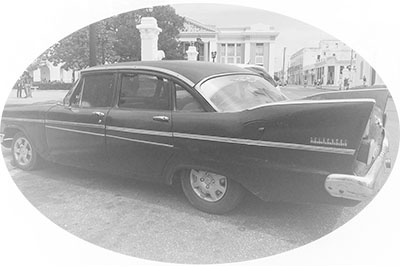
 The vintage cars known in Cuba as almendrones are a distinctive feature of Havana’s urban environment. These classic automobiles, many of them originally manufactured in the United States during the 1940s and 1950s, continue to circulate daily throughout the Cuban capital. They are commonly used as shared taxis as well as vehicles serving visitors exploring the city. Their continued presence reflects the particular evolution of Cuba’s automotive fleet after the political and economic transformations of the mid-twentieth century. Today these historic cars contribute to the visual identity of Havana while remaining part of the city’s everyday transportation system.
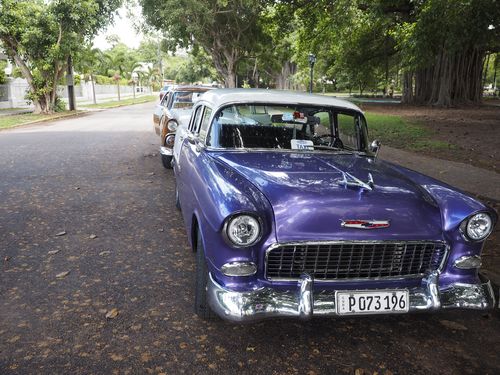
Havana • Oldtimers (almendrones)
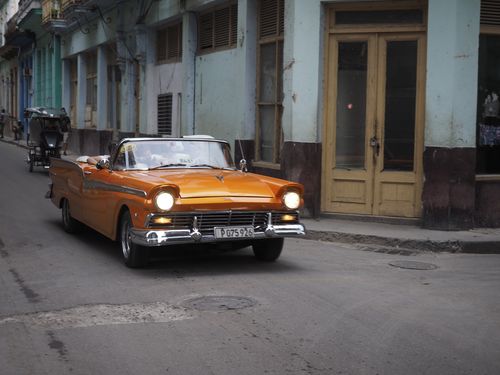
Havana • Oldtimers (almendrones)
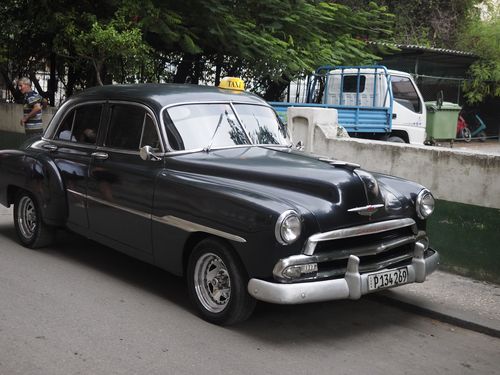
Havana • Oldtimers (almendrones)
Monument profile
Oldtimers (almendrones)
Monument category: Iconic vehicles
Monument family: Museum, remarkable architecture or group of buildings
Monument genre: Cultural or scientific
Geographic location: Havana • Cuba
Construction period: 20th century AD
• Links to •
• List of videos about Havana on this site •
Havana, the capital • Cuba
Historical Development of Oldtimers (Almendrones) in Havana
Arrival of American automobiles in Havana
The vehicles now known in Cuba as almendrones consist primarily of American automobiles manufactured during the 1940s and 1950s. These cars arrived in Cuba during a period when Havana maintained strong commercial connections with the United States, facilitating the importation of vehicles produced by manufacturers such as Chevrolet, Ford, Buick, and Cadillac. The automobiles were initially used by private owners, taxi companies, and urban transport services operating within the capital.
During the mid-twentieth century Havana possessed one of the largest automobile fleets in the Caribbean. Many vehicles imported at that time were designed for urban mobility and offered large passenger compartments and robust mechanical systems. These characteristics contributed to their continued use in later decades. The models introduced during this period formed the foundation of the group of historic vehicles that would later become known collectively as almendrones.
Transformation after the Cuban Revolution
The evolution of Havana’s automobile fleet changed significantly after the Cuban Revolution of 1959. Political and economic transformations altered the island’s commercial relations with the United States. As a consequence, the importation of new American vehicles and spare parts became extremely limited.
Despite these restrictions, the automobiles already present in Cuba continued to be used. The absence of large-scale vehicle imports required owners to maintain and repair existing cars in order to keep them operational. Local mechanics developed a wide range of technical solutions to prolong the lifespan of these vehicles. In many cases, original components were replaced with alternative parts obtained from other vehicles or adapted through local mechanical work.
Through these adaptations, cars originally produced during the 1940s and 1950s remained in circulation for several decades beyond their typical service life. The continued use of these vehicles gradually transformed them into a distinctive element of Havana’s urban environment.
Integration into Havana’s urban transport system
From the second half of the twentieth century onward, many of these vehicles were incorporated into Havana’s informal urban transport network. Numerous car owners began operating their vehicles as shared taxis traveling along relatively fixed routes across the city. These services connected residential districts with central areas and provided an alternative form of public transportation.
The use of almendrones as collective taxis influenced both their operation and internal configuration. Vehicles were often adapted to carry multiple passengers simultaneously, sometimes exceeding the seating arrangements originally intended by the manufacturers. This form of transportation became particularly visible along major urban corridors linking different neighborhoods.
Because of their durability and mechanical adaptability, these automobiles continued to serve an important function within Havana’s transport system for several generations. Their constant presence in daily urban mobility reinforced their association with the city itself.
Present-day role and cultural significance
Today the almendrones remain active on the streets of Havana. Many vehicles still function as shared taxis used by residents for everyday transportation. Others are maintained for tours or short urban circuits intended for visitors exploring the city.
The continued presence of these historic automobiles reflects the long-term adaptation of Havana’s vehicle fleet to economic and technical constraints. Over time, the cars have become strongly associated with the visual identity of the Cuban capital. Their distinctive shapes and colors are widely recognized features of Havana’s streetscape.
Maintaining these vehicles requires continuous mechanical maintenance and periodic replacement of components. Owners and mechanics rely on a combination of restoration techniques and mechanical adaptations to ensure that the cars remain operational.
Global historical context
Most automobiles that today form the group known as almendrones were produced during the 1940s and 1950s, a period marked by the expansion of the American automobile industry following the Second World War. During the same decades, many cities around the world experienced rapid urban growth and increased automobile ownership. Vehicles exported during this era reflected the technological and stylistic innovations of North American manufacturers. In Havana, these models continued to operate long after they had disappeared from regular circulation in other countries.
The almendrones circulate within the historic center of Havana, which was inscribed on the UNESCO World Heritage List in 1982 under the designation “Old Havana and its Fortification System.”
Structural Design and Technical Configuration of Oldtimers (Almendrones) in Havana
Vehicle Configuration and Integration within the Urban Street Network
The vehicles known in Havana as almendrones consist mainly of American automobiles manufactured during the 1940s and 1950s. Their configuration reflects the technical standards of mid-twentieth-century North American automotive engineering. These vehicles typically display a long body, an extended wheelbase and a spacious passenger compartment positioned between a front engine bay and a rear luggage compartment.
Within Havana’s urban structure, these cars operate mainly along major roadways connecting historic districts, port areas and residential neighborhoods. Their physical dimensions correspond to the width and layout of avenues developed during the twentieth-century expansion of the city. The relatively long body and wide turning radius remain compatible with the broad streets and linear circulation routes characteristic of many parts of the capital.
The external silhouette follows a longitudinal composition structured around three volumes. A prominent front hood houses the engine compartment, followed by a central passenger cabin and a rear section containing the trunk. This configuration provides structural balance and contributes to an even distribution of weight along the chassis.
Chassis Construction and Body Structure
The mechanical structure of the almendrones is based on a body-on-frame construction system. In this design, a rigid steel chassis forms the primary load-bearing element of the vehicle. Mechanical components such as the engine, suspension and transmission are mounted on this frame, while the body panels are attached above it.
This arrangement separates the mechanical frame from the outer shell. The chassis absorbs stresses produced during movement, while the body forms the passenger enclosure and defines the vehicle’s exterior appearance. This system was widely used in American automobiles during the mid-twentieth century because it allowed durable mechanical performance and simplified repairs.
The exterior bodywork generally consists of steel panels mounted on an internal metal framework connected to the chassis. The surfaces display rounded volumes and continuous curves typical of automotive design during the 1940s and 1950s. The fenders frequently project outward from the central body, visually widening the vehicle and emphasizing horizontal lines.
The front section commonly includes a wide grille composed of horizontal or vertical chrome bars positioned between two circular headlights integrated into the front wings. The rear portion extends into a large trunk sometimes accompanied by elongated decorative lines or modest tailfins reflecting stylistic tendencies of the period.
Interior Spatial Organization and Passenger Layout
The interior arrangement of the almendrones corresponds to the configuration of mid-century American sedans. The passenger compartment is organized around two principal seating rows: a front bench seat located behind the steering column and a larger rear bench occupying the back section of the cabin.
This layout creates a continuous interior volume allowing several passengers to travel simultaneously. The width of the body and the extended wheelbase provide considerable legroom and enable the accommodation of multiple occupants.
In Havana, numerous vehicles have been modified to increase passenger capacity. Some owners have adapted the interior by widening seating areas or modifying the spacing between seats. These adjustments correspond to the use of the vehicles as shared taxis operating along established urban routes.
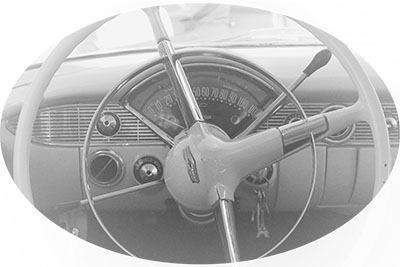
The dashboard follows a horizontal arrangement integrating the main driving instruments within a central panel. Speed indicators, mechanical gauges and control switches are positioned around the steering wheel. Interior finishes generally include painted metal surfaces, chrome details and upholstery made from leather or synthetic materials.
Large windows surrounding the passenger compartment provide extensive outward visibility. This configuration reinforces the sense of spatial openness inside the vehicle and allows passengers to observe the surrounding urban environment.
Mechanical Adaptations and Structural Modifications
Over several decades of continuous use, many almendrones have undergone mechanical modifications intended to prolong their operational life. In numerous cases the original engines have been replaced with power units originating from other vehicle models or later generations of automobiles.
These substitutions required technical adjustments within the engine compartment as well as modifications to transmission systems. Mechanics frequently redesigned mounting points or adapted mechanical interfaces in order to integrate replacement components within the existing chassis structure.
Additional alterations have been introduced in suspension systems, braking mechanisms and fuel supply components. Replacement parts have often been obtained from different automotive models or fabricated locally when original components became unavailable.
Some transformations affect the interior configuration and electrical systems. Seats, wiring installations and lighting equipment have occasionally been replaced or modernized. Despite these mechanical interventions, the external bodywork generally retains the appearance characteristic of mid-twentieth-century vehicle design.
Maintenance, Restoration and Structural Preservation
The continued operation of almendrones relies on regular mechanical maintenance carried out by specialized workshops and individual owners. Repairs address both mechanical systems and visible body structures.
Restoration work frequently includes repairing steel panels, repainting exterior surfaces and reconstructing decorative elements such as chrome trim or moldings. These interventions aim to preserve the recognizable appearance of the vehicles while maintaining their functionality in everyday circulation.
In some cases, extensive restoration projects attempt to reproduce the original configuration of specific models. Such work may involve rebuilding mechanical assemblies or reproducing components corresponding to historical vehicle designs.
Through continuous maintenance, modification and restoration, the almendrones remain active within Havana’s street network. Their elongated proportions, body-on-frame construction and characteristic design continue to form a distinctive technical and visual presence in the urban environment of the Cuban capital.