

 Français (France)
  Nederlands (nl-NL)
 The Cathedral of the Immaculate Conception in Havana is one of the principal religious buildings in the historic center of the Cuban capital. Located on Plaza de la Catedral, it forms a major landmark within the urban layout of the old city. The building is dedicated to the Immaculate Conception of the Virgin Mary and serves as the seat of the Catholic Archdiocese of Havana. The cathedral plays an important role in the religious life of the city, hosting liturgical ceremonies and ecclesiastical events throughout the year. It is also recognized as a significant element of Havana’s cultural and historical heritage.
Monument profile
Cathedral of the Immaculate Conception
Monument category: Cathedral
Monument family: Church, cathedral, basilica, chapel
Monument genre: Religious
Cultural heritage: Christian
Geographic location: Havana • Cuba
Construction period: 18th century AD
This monument in Havana is inscribed on the UNESCO World Heritage List since 1982 and is part of the serial property "Old Havana and its Fortification System".See the UNESCO monuments featured on this site
• Links to •
• List of videos about Havana on this site •
Havana, the capital • Cuba
• References •
UNESCO: Old Havana and its Fortification System
History of the Cathedral of the Immaculate Conception in Havana
Jesuit foundation and construction of the church
The building that later became the Cathedral of the Immaculate Conception in Havana originated as a church constructed by the Society of Jesus during the eighteenth century. Construction began around 1748 on a site located in the western sector of the colonial city, in an area that would later develop into the present Plaza de la Catedral. The initiative was linked to the establishment of a Jesuit college in Havana, an institution intended to provide higher religious education and intellectual formation within the colonial society of Cuba.
The Jesuit complex included educational facilities and a large church designed to serve both the college and the surrounding Catholic community. The construction progressed during the mid-eighteenth century and involved the erection of a substantial stone structure capable of accommodating large congregations. The church was formally consecrated in 1777 and dedicated to the Immaculate Conception of the Virgin Mary.
Before the Jesuit project could fully develop, a major political decision altered the destiny of the building. In 1767 the Spanish monarch Charles III ordered the expulsion of the Jesuits from all territories under Spanish rule. Their properties were confiscated by the Crown, including the newly completed church in Havana. As a result, the building was transferred to the ecclesiastical authorities of the colony and prepared for a different institutional role.
Conversion into the cathedral of Havana
Following the expulsion of the Jesuits, the former Jesuit church was selected to serve as the cathedral of the Diocese of San Cristóbal de La Habana. This change of status was formalized in 1777, when the building became the official episcopal seat of the diocese. The decision reflected the increasing importance of Havana as a major administrative and commercial center of the Spanish Caribbean.
The transformation of the church into a cathedral required adjustments to its liturgical organization and institutional use. The building became the principal location for episcopal ceremonies, diocesan administration, and the most important religious celebrations in the city. The installation of the cathedral chapter reinforced its status as the central religious authority within the diocese.
At the same time, the square located in front of the church gradually evolved into a representative public space. The area came to be known as Plaza de la Catedral, and the surrounding buildings were progressively integrated into the urban composition centered on the cathedral. This development strengthened the relationship between the ecclesiastical institution and the civic landscape of Havana.
The presence of the remains of Christopher Columbus
One of the most notable episodes in the history of the cathedral occurred at the end of the eighteenth century when the remains attributed to Christopher Columbus were transferred to Havana. In 1796 Spain ceded the colony of Santo Domingo to France, prompting the relocation of the remains from the cathedral of Santo Domingo to the Spanish territory of Cuba.
The remains were deposited in the Cathedral of Havana, where they remained for more than a century. Their presence added symbolic importance to the building, which temporarily became the guardian of a relic associated with the history of European exploration in the Americas. The relic was placed within a funerary monument constructed inside the cathedral.
This situation continued until 1898. Following the Spanish–American War and the end of Spanish colonial rule in Cuba, the remains were transferred once again, this time to the Cathedral of Seville in Spain. The removal of the relic marked the conclusion of this significant episode in the cathedral’s history.
Religious function and preservation in the modern period
Throughout the nineteenth and twentieth centuries, the cathedral maintained its function as the principal church of Havana. The building continued to host diocesan ceremonies, major liturgical celebrations, and events linked to the Catholic life of the city. The surrounding square remained an important public space where civic and religious activities intersected.
Political transformations in Cuba during the twentieth century did not lead to the abandonment of the cathedral as a place of worship. After the Cuban Revolution of 1959, the relationship between the Catholic Church and the state changed significantly. Despite these shifts, the cathedral continued to operate as an active religious institution and remained open for liturgical celebrations.
Conservation efforts were undertaken periodically to maintain the structure and interior elements of the building. Restoration campaigns focused on stabilizing the stone fabric of the church, preserving sculptural elements, and ensuring the continued use of the building for religious purposes. These interventions contributed to the long-term preservation of the monument within the historic center of Havana.
Global historical context
The construction of the church that became Havana’s cathedral took place during the mid-eighteenth century, a period marked by the consolidation of Spanish colonial administration in the Caribbean. During the same decades, Bourbon reforms reshaped the political and administrative structure of the Spanish Empire. The expulsion of the Jesuits in 1767 formed part of these reforms and directly affected the history of the building. Across the Atlantic world, the final decades of the eighteenth century also witnessed revolutionary movements that transformed colonial societies.
The cathedral stands within the historic center of Havana, which was inscribed on the UNESCO World Heritage List in 1982 under the official designation “Old Havana and its Fortification System.”
Architecture of the Cathedral of the Immaculate Conception in Havana
Urban setting and spatial relationship with Plaza de la Catedral
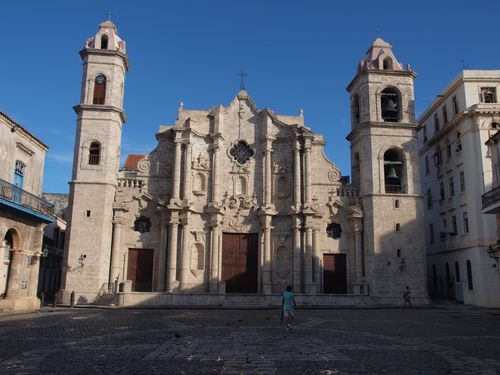
The Cathedral of the Immaculate Conception occupies the western side of Plaza de la Catedral in the historic center of Havana. Its position determines the architectural composition of the square, as the cathedral forms the dominant visual element within the surrounding urban space. The building stands slightly set back from the line of the plaza, creating a forecourt that emphasizes the monumental character of the façade. The open space in front of the church allows an unobstructed view of the entire front elevation and establishes a direct visual axis between the entrance portal and the central area of the square.
The cathedral is oriented approximately along an east–west axis, with the principal façade facing east toward the plaza. The longitudinal mass of the building extends westward behind the façade, occupying a rectangular footprint defined by the nave and side aisles. Adjacent buildings belonging historically to ecclesiastical institutions contribute to the formation of a continuous architectural enclosure around the square, reinforcing the spatial prominence of the cathedral.
The building’s scale differs noticeably from the surrounding residential and civic structures. The height of the towers and the breadth of the façade create a vertical accent within the skyline of the historic district. This vertical emphasis establishes the cathedral as the principal architectural landmark within the square and visually organizes the surrounding urban environment.
Composition of the façade and asymmetrical bell towers
The façade represents the most recognizable architectural element of the cathedral. Its composition is structured around a central entrance portal framed by two bell towers that rise to different heights. The asymmetrical relationship between the towers constitutes one of the most distinctive features of the building.
The southern tower appears slightly broader and heavier in mass than the northern tower. Each tower rises through several architectural levels defined by cornices and openings. The upper levels contain arched openings designed to accommodate the bells. These openings are framed by molded stone elements that emphasize the vertical articulation of the towers.
The central portion of the façade is organized into several horizontal registers. The main portal forms the lowest register and is framed by columns that support an entablature decorated with sculptural details. Above this zone, a sequence of niches and molded cornices creates a gradual transition toward the upper part of the façade. These elements produce a layered architectural composition that enhances the depth of the surface.
The entire façade is constructed from coral limestone quarried in the Havana region. The porous structure of the stone, containing visible fossilized coral fragments, produces an irregular surface texture. This material responds visibly to weathering and contributes to the characteristic appearance of the building’s exterior.
Interior spatial organization and structural system
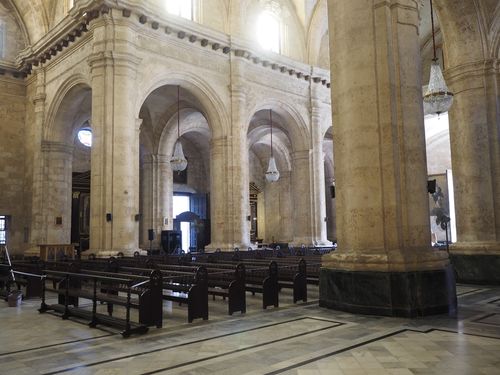
The interior of the cathedral follows a basilican plan composed of a central nave flanked by two side aisles. The nave forms the primary spatial axis of the building and extends from the main entrance toward the sanctuary. Its greater width and height establish a clear hierarchy between the central space and the lateral aisles.
Massive columns divide the nave from the side aisles. These columns support a sequence of arches that define the structural rhythm of the interior. The arches distribute the load of the upper structure and create a regular progression of bays along the length of the building. Each bay corresponds to a segment of the vaulted ceiling above.
The central nave is covered by a series of barrel and cross vaults that extend longitudinally through the interior. These vaults rest on the structural arches supported by the columns and walls. The side aisles are covered by smaller vaults whose dimensions correspond to the narrower width of the spaces they enclose.
Along the lateral aisles, a number of chapels are incorporated into the thickness of the external walls. These chapels contain altars and devotional sculptures and form secondary spaces accessible from the main circulation path. Their presence produces a sequence of recesses along the interior perimeter and contributes to the complexity of the spatial organization.
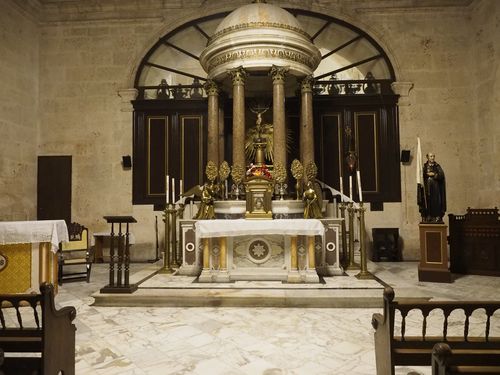
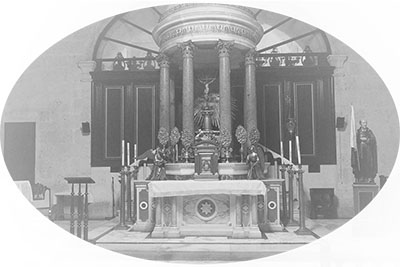
At the western end of the nave lies the sanctuary and the main altar. This area is slightly elevated above the level of the nave floor, marking the transition between the congregational space and the liturgical focus of the church. The elevation emphasizes the visual prominence of the altar within the overall spatial arrangement.
Construction materials and decorative elements
Coral limestone constitutes the principal construction material of the cathedral. Blocks of this stone were extracted from nearby quarries and shaped to form the structural walls and façade elements. The material’s relatively porous composition required thick masonry walls capable of supporting the weight of the upper structures.
The columns, arches, and vaults are formed through masonry techniques that distribute structural loads toward the supporting walls and foundations. The thickness of the walls contributes to the stability of the building while also providing sufficient depth to incorporate chapels and interior recesses.
Exterior decorative elements are carved directly into the limestone. Window frames, cornices, and sculptural niches articulate the surfaces of the façade and towers. The windows themselves are positioned to admit controlled amounts of natural light into the interior while maintaining the solidity of the load-bearing walls.
Inside the cathedral, decorative elements include altarpieces, sculptural figures, and liturgical furnishings installed during various phases of the building’s history. These elements are concentrated primarily within the sanctuary and side chapels, where they define focal points within the spatial composition.
The interplay between the structural framework and the decorative components produces a layered interior environment in which architectural surfaces and artistic elements interact visually. The columns, arches, and vaults create a structural skeleton that organizes the placement of the decorative features.
Architectural modifications and preservation
Throughout its history, the cathedral has undergone several restoration campaigns aimed at preserving the stability of the structure and the condition of its decorative elements. These interventions have focused particularly on the façade and towers, which are directly exposed to the climatic conditions of Havana.
The coral limestone used in the construction is susceptible to erosion caused by humidity and salt carried by maritime winds. Conservation work has therefore included the consolidation of stone blocks, the repair of damaged sculptural elements, and the stabilization of masonry joints. These measures aim to prevent further deterioration of the façade and structural components.
Interior restoration campaigns have addressed the preservation of vaults, columns, and decorative furnishings. Cleaning and consolidation procedures have been undertaken to maintain the integrity of the architectural surfaces and to ensure the continued structural performance of the building.
Urban conservation initiatives in the historic center of Havana have also affected the cathedral’s architectural context. Restoration work carried out around Plaza de la Catedral has preserved the relationship between the church and the surrounding buildings. The maintenance of the square’s architectural unity ensures that the cathedral remains the dominant element within the urban composition of this sector of the historic district.