Français (France)
  Nederlands (nl-NL)
 Traditional incense stick production is a widespread craft activity found in several parts of Asia, including Myanmar. In Ma Au, this manufacturing process forms part of a local economy based on manual skills, family workshops, and religious practices. Incense sticks are commonly used in Buddhist temples, household altars, and ceremonial rituals. Their production involves preparing fragrant plant-based powders applied to thin bamboo sticks before drying. Much of the work is carried out manually in small-scale workshops where different stages of production are organized collectively. Today, incense making continues to play an important role in the economic and cultural life of many artisan villages in Myanmar.
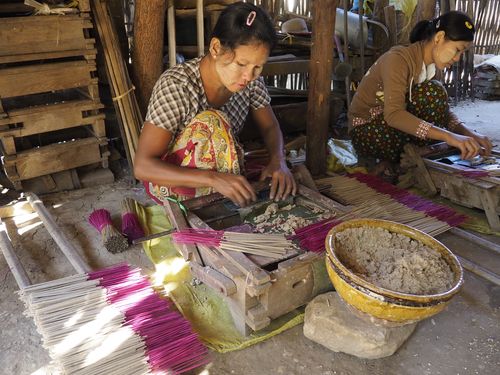
Ma Au • Making incense sticks

Ma Au • Making incense sticks

Ma Au • Making incense sticks
Tradition profile
Making incense sticks
Tradition category: Craftsmanship
Tradition family: Crafts and professions
Tradition genre: Trade and Local Creativity
Geographic location: Ma Au • Myanmar
• Links to •
• List of videos about Ma Au on this site •
Ma Au, a Burmese village • Myanmar
Traditional Incense Stick Production in Ma Au
Origins and Early Development
The manufacture of incense sticks in Myanmar is closely connected to Buddhist religious practices and domestic ritual traditions. Incense has long been used in temples, monasteries, household shrines, funerary ceremonies, and offerings made during religious festivals. The constant demand created by these practices encouraged the development of specialized production centers in several rural regions of the country.
In villages such as Ma Au, incense production gradually evolved into a small-scale craft activity organized around family workshops. The tradition likely developed through the adaptation of older regional techniques using locally available bamboo, aromatic plant materials, resins, and powdered wood. Knowledge was transmitted orally and practically within households rather than through formal guild structures.
The activity became integrated into the broader rural economy, where agricultural work was often combined with seasonal or permanent craft production. Incense manufacturing offered an additional source of income while remaining compatible with village-based family labor systems.
Expansion of the Craft and Economic Role
As Buddhist devotional practices expanded across Myanmar, incense production acquired greater economic importance. Villages specializing in this craft supplied nearby monasteries, religious markets, pilgrimage centers, and urban trading networks. Production was often linked to local trade routes connecting rural workshops with regional distribution centers.
The organization of the craft remained relatively decentralized. Instead of large factories, production was usually divided among numerous household workshops responsible for different stages of preparation, drying, packaging, or transport. This flexible structure allowed communities to adapt production levels according to religious calendars and seasonal demand.
The economic role of incense manufacturing extended beyond purely religious functions. In many rural communities, the activity contributed to household stability during periods when agricultural revenues were limited. Women, elderly family members, and younger generations could all participate in specific stages of production, reinforcing the collective dimension of the craft.
Religious and Social Significance
The importance of incense in Myanmar is directly linked to its symbolic role within Buddhist ritual life. Burning incense accompanies acts of devotion, meditation, merit-making, and offerings to Buddha images. Its use also extends to domestic religious spaces and ceremonies connected with ancestors and local spiritual traditions.
Because of this religious association, incense production is not viewed solely as a commercial activity. In several communities, the craft is regarded as part of a broader cultural and spiritual environment linked to everyday religious practice. Workshops producing incense often maintain close relationships with monasteries, temple festivals, and local religious events.
The craft also contributes to local identity. Certain villages become regionally recognized for the quality, fragrance, or appearance of their incense products. This association between place and production helps preserve the reputation of traditional workshops despite increasing industrial competition.
Modern Transformations and Preservation Challenges
During the twentieth century, traditional incense manufacturing underwent significant changes linked to mechanization, imported industrial products, and evolving commercial networks. Some workshops introduced semi-mechanical techniques to increase productivity, while others continued relying almost entirely on manual labor.
Industrial competition has reduced the number of small family-based producers in certain regions. Standardized mass-produced incense is often cheaper and easier to distribute, placing economic pressure on traditional workshops. At the same time, continued domestic religious use has helped preserve demand for locally manufactured products.
Today, the continuity of incense-making traditions in places such as Ma Au depends largely on intergenerational transmission and the economic viability of small-scale craft production. Rural migration, changing employment patterns, and the declining interest of younger generations in manual trades create additional challenges for the preservation of this specialized knowledge.
Craft Techniques and Production of Incense Sticks in Ma Au
General Organization of the Workshops
In the villages around Ma Au, incense stick production is usually carried out in small family workshops installed in open-sided buildings, shaded courtyards, or simple wooden structures allowing continuous air circulation. The workspaces are organized to separate the different stages of production, including bamboo preparation, mixing of aromatic materials, coating, drying, and packaging.
Production generally follows a repetitive daily rhythm adapted to weather conditions. Dry periods are preferred for large-scale preparation because humidity directly affects the consistency of the mixtures and the drying process. Several members of the same family often participate simultaneously in different tasks, creating a coordinated production system based on manual labor.
The visual organization of the workshops is marked by bundles of bamboo sticks, containers filled with powdered materials, shallow basins used for mixing, and large drying surfaces exposed to sunlight. The production environment remains strongly connected to the surrounding rural setting.
Raw Materials and Preparation Techniques
The manufacture of incense sticks depends on the careful combination of several natural materials. Thin bamboo sticks form the central support of the incense. These sticks are cut to uniform length, sorted according to thickness, and grouped before coating begins.
The aromatic mixture generally contains powdered wood, charcoal dust, bark particles, plant-based binding agents, and fragrant substances derived from resins, roots, herbs, or floral oils. Water is gradually added to create a dense paste capable of adhering evenly to the bamboo surface.
Preparation of the mixture requires constant adjustment of texture and humidity. If the paste becomes too dry, it cracks during drying; if too wet, it fails to maintain a stable cylindrical shape around the bamboo core. Artisans therefore rely heavily on manual evaluation rather than standardized measurements.
Some workshops prepare several fragrance types simultaneously. In these cases, different mixtures are stored separately in shallow trays or covered containers to prevent contamination between aromas.
Manual Gestures and Shaping Processes
The coating stage represents the central technical skill of incense-stick production. In many workshops, artisans moisten the bamboo sticks before rolling them by hand in the aromatic paste. The movement must remain continuous and regular in order to obtain an even coating from one end to the other.
Certain workshops use long wooden boards or inclined rolling surfaces allowing several sticks to be processed together. The artisans repeatedly rotate the sticks between their fingers while applying pressure to maintain consistent thickness. The speed of execution depends on experience and manual precision acquired through years of practice.
After coating, the sticks are aligned in bundles and transferred to drying areas. Drying may take place on bamboo racks, woven mats, wooden frames, or directly on open ground covered with cloth or plastic sheets. The arrangement of the sticks must allow sufficient airflow to prevent deformation and uneven combustion.
The final stages include inspection, trimming irregular surfaces, sorting by size or fragrance, and binding the finished products into compact groups for sale or transport.
Spaces, Participants, and Working Environment
The workshops usually combine indoor and outdoor working areas. Covered spaces are used for preparing mixtures and storing materials, while open courtyards are essential for sun drying. During periods of intense production, large surfaces may be entirely covered with rows of incense sticks placed in radial or parallel arrangements.
The activity often involves several generations within the same household. Older artisans supervise the preparation of materials and the more delicate technical operations, while younger workers may handle bamboo preparation, transport, or drying management. Women frequently play a major role in coating and sorting stages because these tasks require speed and precision.
The atmosphere inside the workshops is dominated by the smell of wood powders, aromatic oils, and resins. Sounds remain relatively limited, consisting mainly of conversations, the friction of bamboo against work surfaces, and the handling of drying bundles. Unlike mechanized industrial production, the rhythm remains closely tied to manual gestures and continuous visual control.
Distinctive Features of the Craft
One of the most recognizable visual aspects of incense-stick production is the large number of brightly colored bundles arranged for drying. In many workshops, the lower ends of the bamboo sticks are dyed red, pink, yellow, or green before packaging. When grouped together, these bundles create dense geometric patterns across the drying areas.
The craft is also distinguished by its combination of repetitive labor and highly precise hand movements. Even slight irregularities in thickness, humidity, or alignment can affect the burning quality of the finished incense. For this reason, experienced artisans continuously monitor texture, weight, and drying conditions throughout the process.
Despite the growing presence of industrially manufactured incense, traditional workshops in villages such as Ma Au continue to rely largely on manual production methods that preserve locally transmitted techniques and visually distinctive forms of craftsmanship.
 Links to the main sections of the site